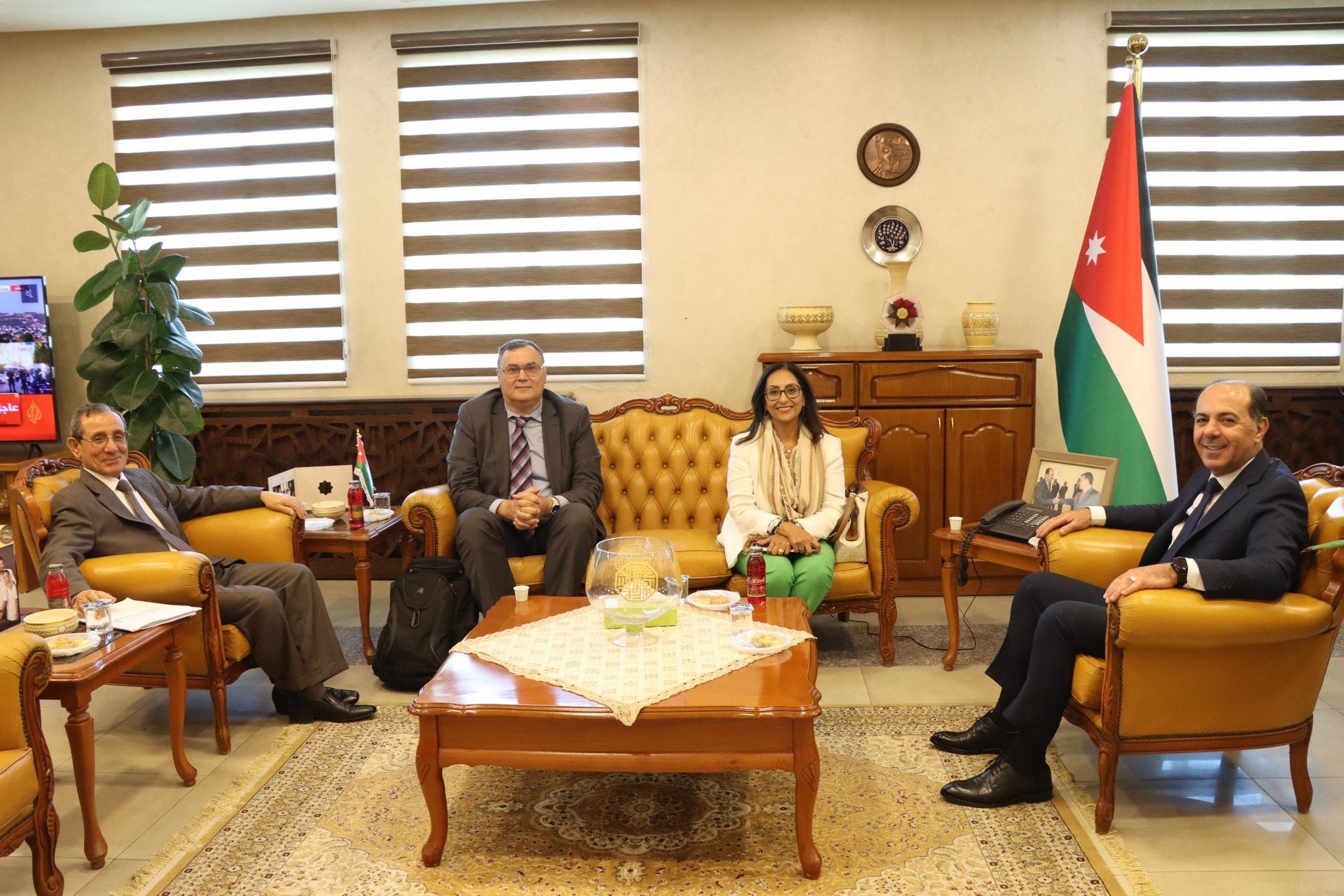
The Secretary-General of the Ministry of Higher Education and Scientific Research, Prof. Dr. Mamoun Debie, met with a delegation from the United Nations Educational, Scientific, and Cultural Organization (UNESCO) at his office on the ministry's premises.
The delegation included Ms. Noha Bawazir, UNESCO Representative in Jordan, and Dr. Basel Al-Ashi, Director of the Technical and Vocational Education and Training Program at UNESCO. The meeting was also attended by Prof. Dr. Ishtawi Al-Abdullah, Chair of the Permanent Academic Committee of the Higher Education Council.
The discussions covered several strategic topics related to enhancing cooperation in the fields of higher education and scientific research, contributing to sustainable development and improving educational outcomes.
One of the main topics was the state of vocational and technical education in Jordan’s higher education sector.
Debie highlighted the Higher Education Council's decisions to allow both public and private Jordanian universities to establish technical colleges.
He discussed the challenges facing Jordanian higher education institutions in this area, including financial obstacles related to infrastructure development and the necessary training for faculty members, as well as the importance of networking with countries leading in technical and vocational education.
Debie also addressed the shift in students' perceptions, noting their increasingly positive view of technical and vocational education.
However, the Ministry of Education cannot accommodate all students wishing to pursue this track, as it requires specialized resources in schools, such as laboratories, equipment, and trained teachers.
Debie further stressed the need to link work in technical and vocational fields with certifications based on knowledge and assessments, which would lead to a skilled workforce that can compete with foreign labor and find employment opportunities in the region.
Additionally, he highlighted the importance of foreign languages for students to break language barriers and be able to work abroad.
During the meeting, real success stories in vocational and technical education in Jordan were discussed, such as the achievements of Al-Hussein Technical University, Amoun University College, and Luminus College, which have successfully aligned higher education outcomes with labor market requirements.
The discussions also covered ways to develop university curricula and adopt the latest educational methods in line with international standards.
Both parties emphasized the importance of exchanging expertise in scientific research, particularly in modern technology, artificial intelligence, and innovation, to support the knowledge economy in the country.
Debie emphasized the need for ongoing dialogue and coordination with UNESCO to strengthen this partnership, noting that such cooperation would contribute to improving the quality of education and achieving the goal of inclusive education for all.
The UNESCO delegation praised the progress achieved in Jordan’s educational sector, stressing the importance of continuing efforts to support higher education and scientific research as a cornerstone for realizing the nation’s vision for sustainable development.
They also expressed readiness to offer more training programs for faculty members and support joint research projects aimed at finding innovative solutions to local and global challenges.